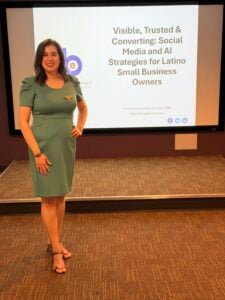
Insights from Digital Summit Philadelphia on how businesses can improve their visibility in Google, ChatGPT, and other AI-powered search platforms.
If you’re a small business owner like me, you may be wondering: Should I focus more on SEO or GEO to grow my business? I actually posted my takeaways on LinkedIn about this and I had ChatGPT “doll” up my post for this blog post, I really enjoyed this read below:
Just when we thought we were getting comfortable with search engine optimization (SEO), along comes generative engine optimization (GEO).
Another acronym to learn, right?
I recently attended Digital Summit in Philadelphia, where I had the opportunity to hear Tom Shapiro of Stratabeat, Inc. present a session titled “Cracking the GEO Code: How to Win in B2B AI Search Today.”
As someone who has spent more than 14 years helping businesses improve their digital marketing and social media presence, I was curious about what this shift means for small business owners, consultants, and B2B professionals.
Here are some of the biggest takeaways I brought home.
First, What’s the Difference Between SEO and GEO?
Before diving into the statistics, let’s clarify what we’re talking about.
SEO (Search Engine Optimization) helps your website become more visible in traditional search engines like Google and Bing.
GEO (Generative Engine Optimization) focuses on increasing your brand’s visibility in AI-generated answers from platforms such as ChatGPT, Claude, Perplexity, and Google’s AI-powered search experiences.
For example, someone might Google “LinkedIn consultant in Allentown, PA.”
But with AI search, that same person might ask:
“Who can help my small business improve its LinkedIn strategy and attract more clients in the Lehigh Valley?”
The opportunity is to make your business easier for both search engines and AI platforms to discover, understand, and recommend.
And here’s why that matters.
Your Potential Customers Are Researching Before They Contact You
One statistic from Tom’s presentation really stood out to me:
70% of the B2B buyer journey is complete before your prospects ever talk with a salesperson (Source: Gartner)
Think about that for a moment.
Your potential customers may already be researching your services, reading reviews, comparing competitors, and forming opinions about your business before they ever schedule a discovery call.
That means your digital presence needs to do some of the relationship-building before you have that first conversation.
As someone who believes strongly in relationship-driven marketing, this reinforces something I frequently share during my workshops: Your online presence should support the relationships you’re building offline.
Is Google Still Important? Absolutely!
One of my biggest questions going into this session was whether businesses should shift their attention away from traditional SEO.
These statistics helped put things into perspective:
Google organic traffic is still often 40-70% of a brand’s overall website traffic event today. 30-40% of your ranking keywords in Google trigger an AI overview. YouTube is now the single most-cited source in Google AI Overviews.
My takeaway?
Don’t abandon SEO just because everyone is talking about AI.
Your website, blog posts, videos, and other online content still play an important role in helping potential customers discover your business.
And if you’re already creating videos, especially educational content, there may be opportunities to make that content work harder for you.
AI Search Is Growing, But Website Referrals Tell Another Story
Here’s another interesting statistic from the presentation:
In terms of growth, AI platform visits grew +28.6% between Jan ’25-Jan ’26 (US desktop & mobile), yet AI referrals to external sites over the same period remained flat. (Source: Similarweb)
This caught my attention because it reminds us that increased visibility doesn’t automatically translate into more website traffic.
Someone might discover your business through an AI-generated answer without ever clicking through to your website.
So how do we measure success?
We may need to look beyond traditional website visits and consider whether people are discovering, recognizing, and mentioning our brands through AI search.
For small business owners, that means thinking about visibility, credibility, and ultimately whether those discoveries turn into meaningful business opportunities.
Want to Know What Your Customers Are Searching For? Listen to Them!
One of my favorite practical takeaways was the importance of Capturing Voice of the Customer (VoC).
In other words, pay attention to the actual questions, challenges, and language your customers use.
Tom shared several places to uncover these insights:
- LinkedIn conversations and questions
- Your most popular content
- CRM wins and losses
- Bing Webmaster Tools, including its AI grounding queries report
His suggestion was to revisit these insights monthly or quarterly.
I especially appreciated this because it’s something small business owners can start doing without investing in expensive software.
For example, if several business owners ask me, “How often should I post on LinkedIn to attract customers?” that question could become a blog post, video, FAQ, or workshop topic.
Rather than guessing what people want to know, we can create content based on what they’re already asking.
How Do You Measure GEO Success?
Another important lesson was that your business may appear in one AI platform but not another.
For example, you might have strong visibility in ChatGPT but very little visibility in Claude.
Tom discussed tracking brand mentions in large language models (LLMs), especially from non-branded prompts.
Why non-branded?
Because asking an AI platform about your business by name is different from asking it to recommend businesses in your industry.
For example:
“Tell me about Beyond Engagement Social Media Solutions.”
Versus:
“Who are some LinkedIn trainers and digital marketing consultants serving small businesses in the Lehigh Valley?”
The second question can help you understand whether your business is being surfaced when someone doesn’t already know your name.
And when measuring results, it’s important to keep your data clean and your testing consistent.
GEO Strategies That Small Businesses Can Explore
Tom also shared several GEO levers that may help brands improve their visibility in AI-generated answers.
Here are some that stood out to me.
1. Build Your Website’s Authority
Domain Rating (Websites with highest Ahrefs domain ratings (domain 81-100) achieved 5.5x higher brand visibility in ChatGPT than websites rating up to 60.
This reinforces the importance of building a credible digital presence over time.
For smaller businesses, that might include earning relevant backlinks, being featured in industry publications, participating in podcasts, and creating helpful content that others want to reference.
2. Publish Original Research
Original Research (Websites featuring original research achieved 28.7& higher brand visibility in ChatGPT than websites without original research)
Note: The 28.7& figure should be verified against the presentation before publication.
Original research doesn’t necessarily mean conducting a massive national survey.
It could mean analyzing trends among your customers, sharing findings from a small survey, or publishing insights based on your professional experience.
For example, I could survey business owners about their biggest LinkedIn challenges and share those findings in a blog post.
That would create content based on information gathered directly from my audience.
3. Create Competitor Comparison Pages
Competitor Comparison Pages (Websites with competitor comparison pages achieved 28.8 higher brand visibility in ChatGPT than websites without comparison pages)
Note: Confirm whether 28.8 refers to a percentage or another measurement before publication.
Comparison content can help potential customers understand the differences between services, approaches, and solutions.
For example, a marketing consultant might publish an article comparing one-on-one LinkedIn coaching with a group workshop.
The goal isn’t to criticize competitors. It’s to help buyers make informed decisions.
4. Explore “Best” Lists and Listicles
Think about how often people search for the “best” tools, services, or strategies for their needs.
Helpful, well-researched lists can answer those questions and make information easier to navigate.
Examples might include:
- Best LinkedIn strategies for small business owners
- Best ways to improve your digital visibility without a large marketing budget
- Best questions to ask before hiring a digital marketing consultant
The key is to provide genuine value rather than creating lists simply to attract attention.
5. Don’t Overlook FAQs and Customer Reviews
Two other GEO opportunities Tom mentioned were FAQs and customer reviews.
These are especially relevant for small businesses.
FAQs help answer the questions your audience is already asking, while customer reviews provide valuable context about real experiences with your business.
If you’re already receiving great questions during discovery calls, networking events, or workshops, consider turning those questions into helpful content on your website.
So, Should Small Businesses Focus on SEO or GEO?
My biggest takeaway from Digital Summit Philadelphia is that SEO and GEO should work together, not compete for our attention.
Traditional SEO helps customers discover your website through search engines.
GEO creates additional opportunities for your expertise and business to appear in AI-generated answers.
But neither replaces the importance of understanding your customers, creating useful content, and building trust.
For small business owners with limited time and resources, I’d recommend starting with the fundamentals: maintain a helpful website, answer your customers’ questions, share your expertise, and make sure your business information is consistent across platforms.
Then begin exploring how your business appears in AI search.
You don’t have to do everything overnight.
My Next Steps After Digital Summit Philadelphia
I’m leaving this session with several ideas I want to explore for my own business, Beyond Engagement Social Media Solutions.
I want to become more intentional about the questions my customers ask, how I structure my website content, and how my expertise appears across different AI platforms.
And yes, I’ll be paying closer attention to whether ChatGPT, Claude, and other AI tools can discover my business when someone searches for the services I provide.
After more than 14 years in digital marketing, one thing remains consistent: the platforms will continue changing, but understanding your audience and providing value will always matter.
A big thank you to Tom Shapiro of Stratabeat, Inc. for sharing these insights at Digital Summit Philadelphia.
I now have more strategies to explore to improve my chances of showing up in LLMs. Hopefully!
Now I’m curious: Have you ever searched for your own business in ChatGPT or another AI platform? What did you discover?
Need Help Improving Your Digital Visibility?
I’m Valentina Escobar-Gonzalez, MBA, founder of Beyond Engagement Social Media Solutions. I help small business owners, entrepreneurs, and corporate professionals strengthen their digital marketing presence through LinkedIn strategy, practical training, and personalized consulting.
Based in the Lehigh Valley, Pennsylvania, I work with clients locally and virtually, offering services in English and Spanish.
If you’re ready to become more intentional about your online visibility, let’s connect.
Visit Beyond Engagement to learn more about my consulting, speaking, and workshops.